
AHMED MATER
(born Tabuk, Saudi Arabia, 1979)
2010
Five light boxes, edition 5/8
79.2 × 59.4 cm each light box
H0399
Ahmed Mater is an interdisciplinary artist who uses photography,
film, sculpture and performance to document and dissect the
realities of contemporary Saudi Arabia. Mater’s training as a
physician has informed his artistic practice, which employs
research-based investigative techniques to unveil unofficial
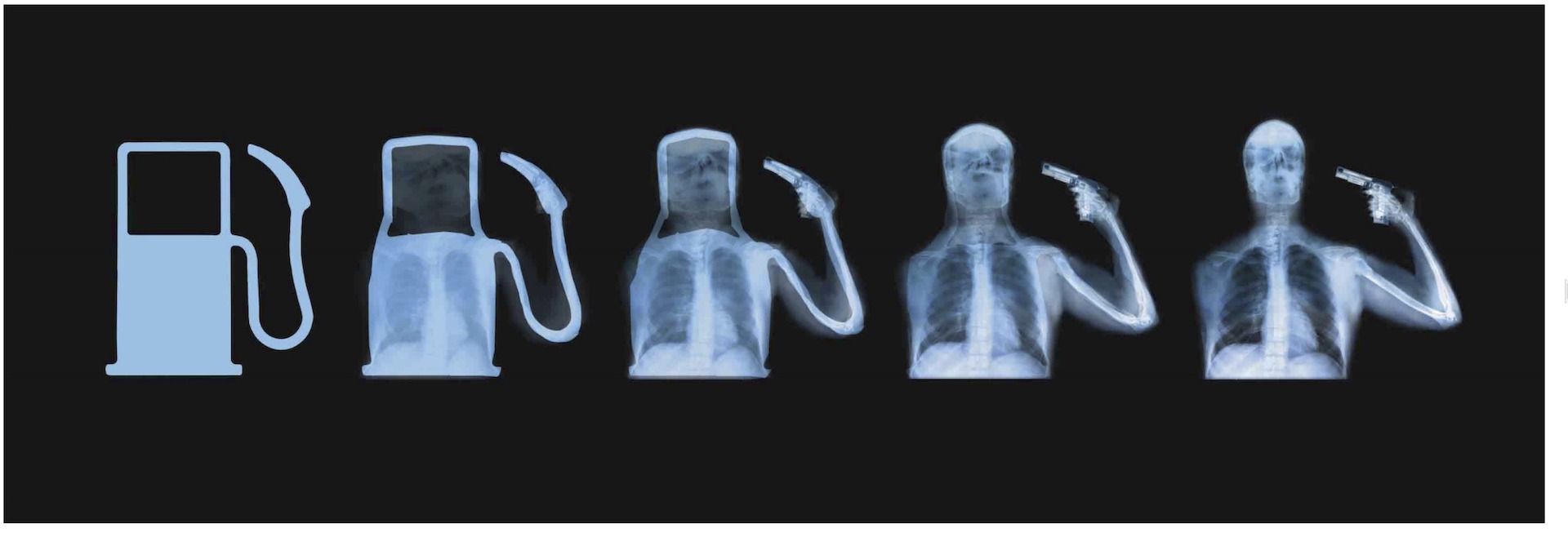
histories and probe collective memories.1 Evolution of Man
scrutinises the environmental and social risks of oil through a
provocative series of images illuminated in individual LED light
boxes. The oscillating forms radiate out towards the viewer,
stunning in their crisp glow and graphic clarity. Placed side by
side, the images are meant to be read sequentially as the shifting
silhouettes mutate from the simplified representation of a gasoline
pump to the X-rayed torso of a man holding a gun to his head.
Conversely, the direction of ‘evolution’ is not dictated by the
artist creating a recursive loop wherein a cycle of success and
suicide flows unremittingly between man and machine. Indeed,
Mater is known for his interrogations of the relationship between
oil and its conflicting contexts of rapid economic development
and sociocultural and environmental degradation. Exploring the
contradictions of oil prospecting and production, he represents
oil as a substance and industry that in many ways brings great
prosperity, but also poverty.
With an aesthetic characteristic of Mater’s larger oeuvre,
Evolution of Man relies on the visually powerful index of the
X-rayed human form, combining the dual trajectories of the artist’s
professional life as an artist and a medical doctor.2 A symbol of
technological advancement in the modern age, an X-ray is both
a helpful diagnostic tool and a frightening vision of human frailty.
Its illuminated structures and darkened cavities evoke anxieties of
illness, fragmentation and decay. Produced in 2010, Mater refers to
Evolution of Man as a warning against a ‘spiral of destruction’.3 In
2016 Mater transferred the work to a series of five fabric prints and
installed them as flags on a hill in Standing Rock, North Dakota.4 The
site became famous for its widespread protests by First Nations
Americans against the Dakota Access Pipeline, a conduit for the
transportation of oil across the sacred lands of the Sioux peoples.